


What wildlife can you see while paragliding in Chamonix?

Photos of David Carpano : the wildlife photographer of the Mont Blanc region
The Chamonix valley is predominantly populated by herbivorous mammals. Many birds can be found in the air.
Herbivores
The chamois: an iconic animal of Chamonix
On foot, to spot chamois, you need to be very discreet, as their sight and smell allow them to detect an intruder in their territory from over half a kilometer away. Furthermore, although they are easily identifiable by their coat and the shape of their horns, chamois are difficult to observe because they are discreet, agile, and blend into the landscape. They measure approximately 70-80 cm at the shoulder. Males and females look very similar: light coat in summer, dark and dense in winter. The main differences are in build (females are slimmer than males, 25-30 kg compared to 30-40 kg for males) and horns (around 25 cm, more hooked in males). Incredible climbers.
They are numerous in the valley, but it's impossible to see them up close on foot; they sense or see us and hide.
However, we often see them when paragliding, most of the time, if we don't startle them, they allow themselves to be observed

The ibex
It lives in groups, and herds can reach up to 100 individuals! It's also common to hear them fighting, horns clashing, with impacts echoing through the valleys. The ibex was long hunted for its meat and horns (which grow throughout its life) to the point of near extinction in the 19th century. Since then, several protection and reintroduction programs have been implemented.
Males can weigh up to 110 kg and stand 80 cm tall at the shoulder. Their ridged horns can measure up to 1m long. They are numerous in the valley and protected. We often see them when paragliding. It's a real treat!

Deer and hinds
Common in the mountains of Western Europe. Stripped bark on trees is a sign of their presence, as it's one way they mark their territory. From December to August, stags and hinds live separately, but at the end of summer, around mid-September, you can hear the males' rutting call, the famous roar that signals mating season!
When spotted, they are often in small groups. A group of 3 hinds is seen very regularly near Planpraz.
Marmots
The marmot is a shy and cautious rodent mammal. Its elongated body is covered with beige fur on its belly, grey around its ears and head, and brown on the rest of its body. It feeds on roots, leaves, and flower stems. It lives in groups in alpine pastures and digs large, branched burrows where it takes refuge in case of danger and to hibernate. When it hears or sees a predator (fox or golden eagle), it emits a cry that resembles a series of very loud whistles.
When they fly, you hear them more often than you see them. They have a very distinctive whistle. If you're not familiar with it, you could easily mistake it for a bird whistling. Their whistle allows them to signal danger or a predator.
They are so cute.

The birds
The golden eagle
The golden eagle is perhaps the most dangerous winged predator in the Alps. Its speed, eyesight, strong talons, and powerful beak make it a highly effective predator. Its size varies, but its wingspan is about 2 meters, making it easily recognizable when it flies overhead. The golden eagle is an opportunistic animal; it generally feeds on small mammals (rabbits, hares, marmots, voles) but also on young chamois or ibex, foxes, snakes, etc. If prey is scarce, it can also feed on carrion.
It's a great joy to encounter them in the Chamonix sky.

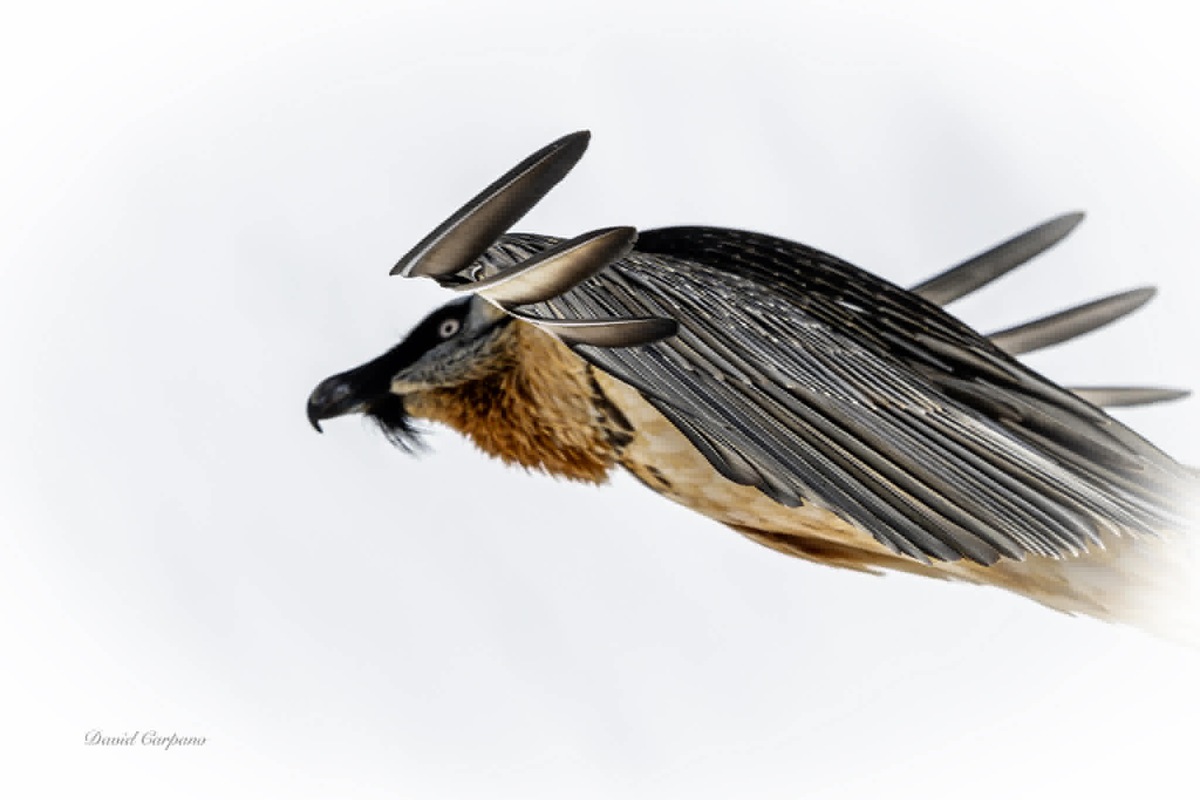
The bearded vulture
The bearded vulture is a scavenger from the Vulture family, and its recent history in the French Alps has been eventful. Having disappeared from the Alps at the beginning of the century, it was reintroduced about thirty years ago, and by 2012, there were 48 individuals in the French Alps.
The bearded vulture, with its very distinctive plumage and head, gets its name from the tuft of black feathers it has under its beak. It's a very large bird that can reach a wingspan of 3 meters! It is sometimes nicknamed the "bone breaker" because it drops bones that are too large to break them open and eat the marrow and ligaments.
Flying with bearded vultures is particularly moving.
The common kestrel
Its silhouette in flight is very distinctive, especially when it hovers in place called "Holy Spirit". Its wings are long and pointed, its tail very long and rounded. Its upperparts are rufous with some brown spots (more pronounced in females) and the wingtips are dark brown.
They live in pairs and are very often seen flying in the same areas.
Predators
The fox
It's quite rare to spot a fox while paragliding, but it does happen. I particularly enjoy looking for animals when I fly... and sometimes you hear marmots whistling at the top of their lungs... that's often due to a fox annoying them.

The wolf
Wolves are in the mountains, that's obvious. I was lucky enough to see one while flying in April 2026! What an encounter!
The lynx
Some paragliders have already seen them, and I'm eagerly awaiting that encounter!
.jpg)